Strolll - Augmented Reality glasses and software platform

Therapy without the usual limits
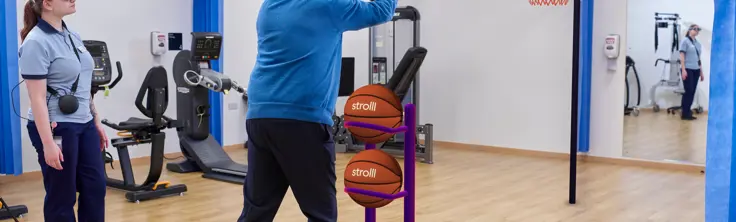
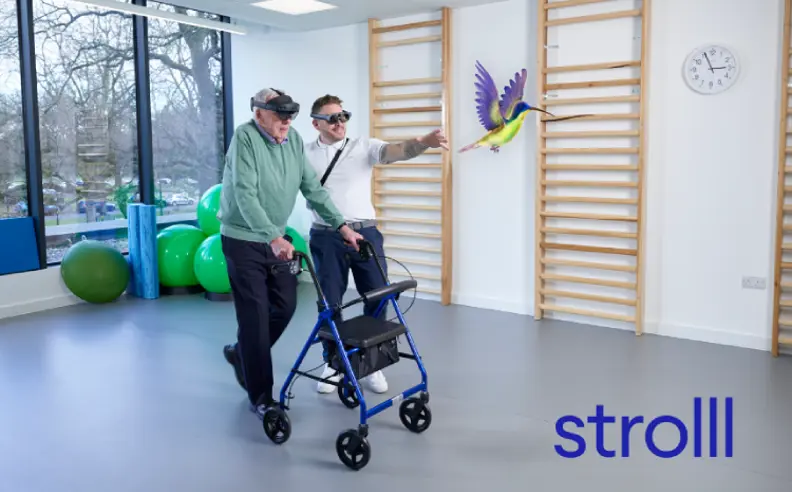
Strolll is an augmented reality (AR) platform that supports neurorehabilitation for people with neurological conditions such as Parkinson’s disease, stroke, and multiple sclerosis. Strolll uses augmented reality to increase engagement, support progression, and help clinicians deliver effective neuro rehab.
- Using AR glasses, patients perform gait, balance, motor, and cognitive training while remaining safely connected to their real-world environment.
- Strolll can be used in lying, sitting, standing and walking situation, focusing on movement, cognitive double-tasks, arm and balance exercises.
- The platform enables therapists to deliver engaging, task-oriented rehabilitation in both clinical and home-based settings.
- Strolll provides objective performance data and progress tracking to support personalized treatment and outcome measurement.
By increasing therapy intensity, accessibility, and patient engagement, Strolll helps rehabilitation providers deliver more effective and scalable neurological care.
Rehab exercises
Strolll's platform is built around two core components: rehab games (1) and a gait training module (2). The third key component 'Assessments' will be added on short term, adding standarized 6MWT, 10MWT, Romberg, 5XSTS and TUG.
The rehab games, usable in the full scope of early rehab to ambulant rehab, target functional mobility — gait, balance, reaching, and hand-eye coordination — using gamified, interactive tasks projected into the patient's real environment to boost engagement and increase rehabilitation time compared to traditional paper-based exercise sheets. Cognitive training exercises and memory games are also included to support attention and cognitive function alongside motor recovery.
The gait training module uses multi-sensory visual and audio cues overlaid onto the user's surroundings, personalized to the individual. This cueing helps patients — particularly those with Parkinson's disease — shift from impaired "autopilot" movement control to goal-oriented movement, often producing immediate improvements in walking, posture, and balance, and is especially aimed at reducing freezing of gait and falls risk.


Strolll's FAQ
No. Strolll uses augmented reality with transparent lenses, so patients remain aware of their surroundings and therapy happens in the real environment.
No. There are no controllers, sensors, or attachments required. Everything is delivered through the headset.
The portal allows clinicians to create and save therapy programs, track session activity, and monitor patient progress over time, all in one place.
Yes. Clinicians can build and save programs based on patient needs, then quickly load them for future sessions.
Yes. Session data can be referenced to support clinical reasoning and demonstrate patient progress.
Strolll is used as part of therapy, not separate from it. Clinicians integrate it into sessions to increase engagement, intensity, and focus across different treatment goals.
No. Strolll can be used from early-stage rehab through higher-level mobility. Patients can start in supine or seated positions and progress to standing and walking as appropriate.
Yes. Strolll supports motor, gait, balance, and cognitive-motor training within the same session, allowing you to address multiple impairments without switching tools.
Yes. Depending on the country, Strolll is used as part of standard therapy sessions and supports skilled interventions already covered under existing therapy codes.
Strolll can be deployed with minimal IT burden. Our team works with your organization to ensure a smooth setup based on your requirements.
Yes. Strolll follows established data security practices, including encryption and secure data handling aligned with healthcare standards.
Contact
Curious how this would work in your clinic?
We'll walk you through exactly how it fits your patients and your workflow.